Coordinator for Green Technologies, ManuFuture LAB | Innovation Development Department
Publication date 2026-08-28
Critical Raw Materials Act opportunities for businesses
In March 2024, the Council of the European Union gave its final approval to the Critical Raw Materials Act (CRMA). Through the Act, the EU aims to ensure a secure and sustainable supply of critical raw materials for European industry and significantly reduce its dependence on imports from individual supplier countries.
Main objectives:
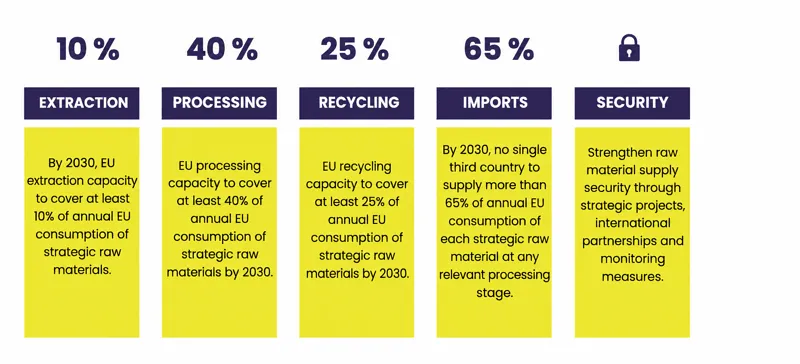
Critical and strategic raw materials:
Metals, minerals and natural materials are an integral part of our everyday lives. These materials are essential to European industry and the technology sector.
Industry sectors:
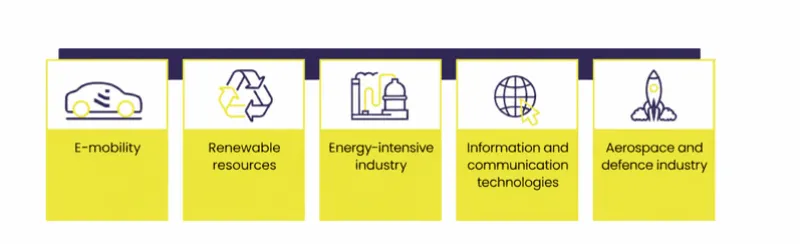
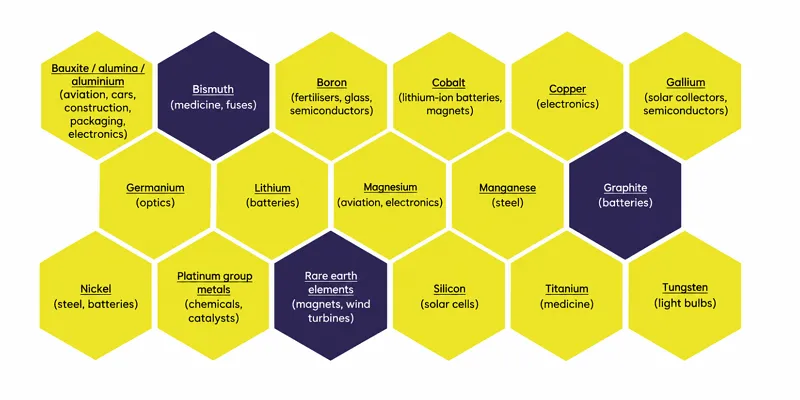
A distinction is made between critical raw materials and strategic raw materials. The Critical Raw Materials Act identifies 34 critical raw materials, of which 17 are considered strategic.
Strategic raw materials and examples of use:
CRMA Strategic Projects and opportunities for companies
A common EU framework has been established to identify and support selected raw material projects by recognising them as Strategic Projects. These projects benefit from simplified and predictable permit-granting procedures and support in accessing finance. The first 47 Strategic Projects recognised within the EU have a combined expected capital investment of approximately EUR 22.5 billion.
At present, Lithuania has no significant extraction projects involving strategic raw materials covered by the CRMA. Its greatest potential therefore lies in raw material processing, recovery from waste, batteries and electronics, the development of alternative materials, and research and innovation activities.
Applications for Strategic Project status are submitted in response to calls published by the European Commission and within the specified deadlines. The second cut-off date for applications was 15 January 2026.
In March 2025, the European Commission recognised the first 47 Strategic Projects in 13 EU Member States: Belgium, France, Italy, Germany, Spain, Estonia, Czechia, Greece, Sweden, Finland, Portugal, Poland and Romania. A further 13 Strategic Projects outside the EU were recognised in June 2025, bringing the total recognised in those two rounds to 60.
For example, the POLVOLT recycling project in Poland aims to contribute to the supply of nickel, copper, cobalt, lithium, platinum group metals and manganese. In Estonia, the CO2Graphite processing project aims to contribute to the graphite supply chain.
Of the first 47 recognised EU Strategic Projects, 10 involve recycling, and many focus on the lithium, cobalt, nickel, manganese and graphite value chains. This creates further opportunities for Lithuanian companies working with batteries, electronic waste, metal recycling and the circular economy.
Permit granting procedures:
Strategic Projects benefit from accelerated permit-granting procedures. Under Article 11 of the CRMA, the permit-granting process should not exceed 27 months for Strategic Projects involving extraction and 15 months for Strategic Projects involving only processing or recycling, subject to the Regulation’s applicable exceptions and rules on calculating these periods.
Relevant permitting links:
- Spatial planning and building permit system
- InfoStatyba — building permits, state construction supervision and permits issued by municipalities
- Environmental impact assessment of proposed economic activities
- ALIS — Environmental Permits Information System
- Information on pollution permits and integrated pollution prevention and control permits
- Requirements for companies carrying out waste recovery and disposal
Innovation Agency Lithuania
- Provides advice on project preparation and sources of financing.
- Promotes cooperation between research organisations, businesses and public authorities.
- Shares information on potential calls for proposals, EU partnerships, pilot projects and market diversification opportunities.