Industry Manager for Green Technologies, ManuFuture LAB | Innovation Development Department
Publication date 2026-08-28
Net Zero Industry Act opportunities for businesses
The Net-Zero Industry Act (NZIA), adopted by the European Parliament and the Council, entered into force in June 2024. The Regulation aims to increase clean technology manufacturing in the EU, accelerate the transition to a climate-neutral economy and strengthen the resilience of European industry.
NZIA objectives:
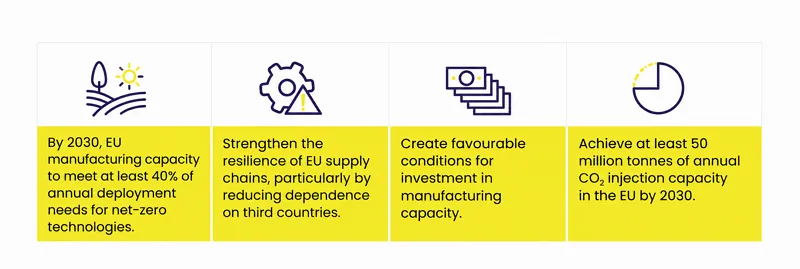
Clean technologies of strategic importance
Net-zero technologies include final products, specific components and specific machinery primarily used to manufacture those products. These technologies are of strategic importance because of their role in the transition to a climate-neutral economy.
Key Net-Zero Technology Areas:
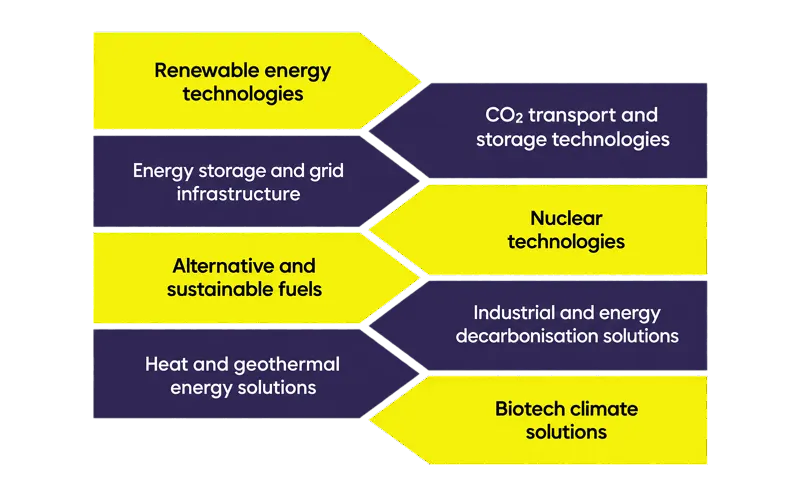
The full list of technologies is set out in Article 4 of the NZIA Regulation and in the Annex to the Delegated Regulation, which also lists components primarily used to manufacture these technologies.
NZIA strategic projects and opportunities for companies
Projects that meet the objectives of the NZIA and contribute to the development of the EU’s net-zero industry may be granted net-zero strategic project status.
What is an NZIA strategic project?
The source page describes strategic projects under the Net-Zero Industry Act as projects that:
- Manufacture clean technologies.
- Are strategically important for achieving climate neutrality.
- Make a significant contribution to expanding EU manufacturing capacity.
- Help safeguard security of supply and reduce dependence on third countries.
- Meet high environmental, social and governance (ESG) standards.
- Can be implemented within a reasonable timeframe and have a clear financing plan.
Formal eligibility and recognition are assessed under Articles 13 and 14 of the NZIA. The points above provide a general description rather than a complete set of statutory selection criteria.
Benefits of strategic project status
- Faster permit-granting procedures — the overall time limit for strategic manufacturing projects is generally 9 months for annual manufacturing capacity below 1 GW and 12 months for annual manufacturing capacity of 1 GW or more. A 12-month limit also applies where annual manufacturing capacity is not measured in GW, subject to the Regulation’s specific rules and exceptions.
- Simplified administration of permitting — a single point of contact coordinates the permit-granting process. In Lithuania, this is Invest Lithuania.
- Support in accessing financing opportunities, including advice on relevant instruments such as Horizon Europe, InvestEU and the Innovation Fund. Strategic project status does not itself guarantee funding.
Application and selection process
- Submission of the application
The project promoter — a company or a consortium implementing a net-zero technology manufacturing project — applies for strategic project status using the European Commission’s prescribed electronic application process. The application is assessed by the relevant Member State. In Lithuania, the contact institution identified on this page is Invest Lithuania. - National assessment
The national authority assesses the application against the NZIA criteria, including the project’s contribution to the Regulation’s objectives. The application also provides information on implementation feasibility and financing. - Decision
The relevant Member State decides whether to grant net-zero strategic project status. Recognised projects are made publicly available. - Project implementation
Once strategic project status has been granted, the project promoter proceeds with implementation. Invest Lithuania provides advice on permit-granting procedures.
Detailed information on the application and selection process.
Permit granting procedures
The NZIA sets maximum time limits for granting permits for new or expanded net-zero technology manufacturing projects. For projects without strategic status, the following limits apply according to annual manufacturing capacity:
- Below 1 GW — 12 months.
- 1 GW or more — 18 months.
An 18-month limit also applies to manufacturing projects whose annual manufacturing capacity is not measured in gigawatts, for example projects manufacturing carbon capture and storage (CCS) technologies. The shorter limits for strategic projects are set out in the previous section.
In exceptional cases, where the nature, complexity, location or size of a project requires it, the responsible authority may extend the applicable time limit once by up to three months, on a case-by-case basis. Other specific rules and exceptions in the Regulation remain applicable.
The permit-granting process covers the relevant permits required to build, expand, convert and operate net-zero technology manufacturing projects. This includes construction, chemical and grid connection permits, environmental impact assessments and other authorisations.
Useful links:
Innovation Agency Lithuania:
- Provides a one-stop advisory service on the Regulation and financing opportunities for strategic projects.
- Promotes cooperation between research organisations, businesses and public authorities.
- Shares information on potential calls for proposals, EU partnerships, pilot projects and market diversification opportunities.
- Provides the European Commission with data on market trends in net-zero technologies.