Progressive metal die-stamping is a complex but the most efficient production process for sheet metal products and is widely used in mass production for end products such as cars and other vehicles, household appliances, electronics and energy components, furniture and construction products. The production process depends on many different parameters such as material properties, wear of tool parts, lubrication efficiency.
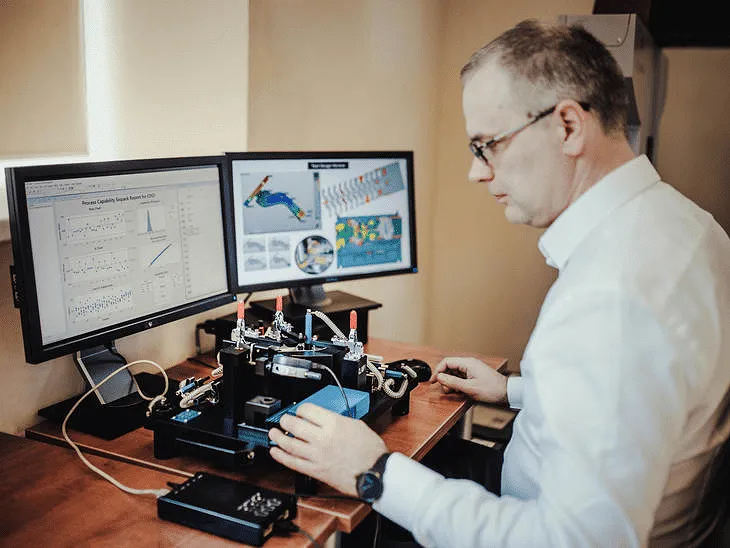
Stansefabrikken Automotive took an innovative approach and applied research methods that led to the development of relevant hypotheses and the establishment of a relationship between the die, the sensor signals installed in the quality inspection device, the process parameters and the quality attributes of the finished part. Based on the correlations found, the company has developed a controller that assesses the status of the process and the quality of the part and informs the operator thereof.
“Unfortunately, the metal die-stamping tools that are currently being developed do not have any way of monitoring the die-stamping process as it is happening, but use separately mounted sensors that are recorded by separate systems that are not integrated with each other, which is inefficient because we are assessing the quality of the finished product when it is too late to change anything. To solve this problem, we have developed a solution that allows us to measure parameters throughout the entire production process, thus ensuring quality at every stage of production,” says Dmitrij Triškin, Head of Technology at UAB Stansefabrikken Automotive.
Mr. Triškin says that thanks to the investment in equipment upgrade, technicians can monitor various parameters such as force, pressure, speed and the position of the die-stamping machine parts during the metal die-stamping process. These sensors provide the control system with real-time data and allow quick adjustments to be made to the process in order to maintain consistent quality and avoid product defects.
“Monitoring the sensor signals helps to identify potential problems before they become serious and to carry out maintenance in time, thus preventing costly troubleshooting and shortening downtime. Obviously, even the most experienced operator cannot monitor and control all the variables simultaneously. We believe that smart monitoring technologies will detect changes in process and environmental parameters, identify the causes of problems and offer the most appropriate solutions in the future die-stamping process,” says Mr. Triškin.
He believes that the R&D project has been meaningful and valuable, and the company is closely monitoring new calls for funding opportunities and plans to continue investing with the support of EU investment.
“During the project, we presented prototypes to new customers, who showed great interest in the product. This is already translating into real orders and new partnerships, and our experience is also planned to be used by the fast-growing renewable energy industry – we have started cooperation with one of the largest battery and energy storage manufacturers in Europe,” comments Mr. Triškin.
The results of studies carried out by the National Institute of Standards and Technology (NIST) and other research were used to prepare the report on project results. It was found that reducing downtime due to tool problems or equipment failure will increase overall production efficiency by 30 per cent thanks to press force monitoring. Production quality will also increase significantly, with up to 40 per cent fewer quality defects by using sensors to monitor the die-stamping process and digital quality control.
The Innovation Agency will soon launch new EU investment calls, “InoProgress” and “InoMaturity”, to help companies in Lithuania to continue or start new R&D activities.
“Businesses planning similar changes are already invited to follow the calls announced by the Innovation Agency, consult our experts and submit project implementation plans for European funding. We are proud of the businesses operating in Lithuania that are creating innovative solutions that raise the country profile and increase business competitiveness,” says Agnė Vaitkūnienė, Director of the Investment Management Department of the Innovation Agency.
To strengthen the Lithuanian economy, by the end of 2023 the Ministry of Economy and Innovation plans to implement measures totalling almost EUR 1 billion. Of this amount, EUR 365 million has been earmarked for business, innovation and investment.
All current and forthcoming calls with detailed descriptions and terms are available on the website of the Innovation Agency. The Innovation Agency also provides free advice on starting and growing a business and on choosing the right financing instruments.