“We want to encourage innovation and effectively tackle the persistent pollution problems of Lithuanian industry. We invite entrepreneurs to take advantage of this opportunity to strengthen their competitiveness and introduce environmentally friendly solutions. In this way we are creating more opportunities for Lithuania together,” says Aušrinė Armonaitė, Minister of the Economy and Innovation.
The “Green Experiment” call has a budget of EUR 8 million, with the minimum amount of funding available for a project being EUR 50 000 and the maximum amount being EUR 500 000. Funded activities include the development of innovative technologies that promote the production of environmentally friendly and sustainable products. The funding will be available for businesses to invest in research and experimental development (R&D) as well as patenting activities.
“The “Green Experiment” call is designed to encourage businesses to collaborate with scientists to find ways to tackle persistent pollution problems in Lithuanian industry. One of these is the mounds of mineral waste, known as phosphogypsum, accumulating in Central Lithuania. By making a breakthrough and introducing an innovation to recycle this waste from the fertiliser industry, we could strengthen the global competitiveness of national companies and contribute to the green goals of Lithuania and Europe,” says Paulius Petrauskas, Director of the Breakthrough Department of the Innovation Agency.
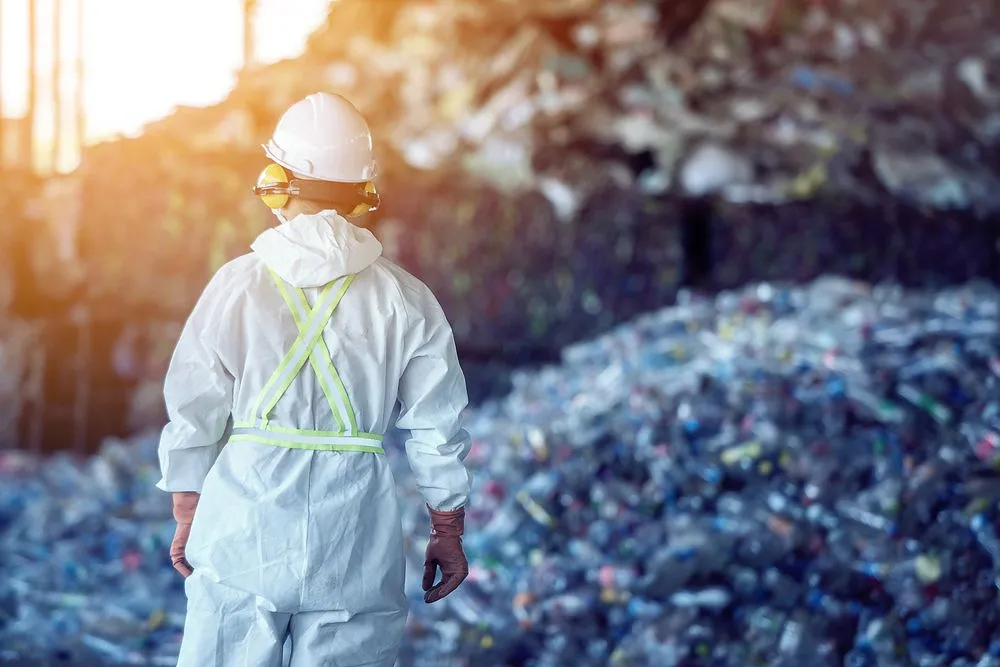
It is estimated that in 2021, more than 1.7 million tonnes of artificial mineral waste from the fertiliser production cycle were collected in Lithuania. The industrial waste landfills, growing each year, can only be managed by recycling. To address this problem, the Innovation Agency has already organised a series of training sessions for companies that could work together with research institutions to tackle this industrial waste problem. Around 80 companies, researchers from Kaunas University of Technology, Vilnius Gediminas Technical University (Vilnius TECH) and several universities of applied sciences participated in the training.
More sustainable products
Eligible applicants under the “Green Experiment” measure are micro, small and medium-sized enterprises (SMEs) that have been active for at least 3 years. Eligible partners include SMEs, research and study institutions, and large enterprises. Project applicants are required to have an average annual sales revenue from their products or services of more than EUR 145 000 over a period of 2 years, and at least 51 per cent of their sales must come from their own production. The “Green Experiment” call is open to companies in Central and Western Lithuania. The Capital Region is not eligible for funding under this call.
“Although this measure is similar to the previous “InoProgress” and “InoMaturity” calls, the products developed under the “Green Experiment” will have to be exceptionally sustainable. A sustainable product is a product that is made to be durable, long-lasting, energy or resource efficient, repairable, recyclable, with at least one of the constituent materials or parts of the product made from recycled materials, and which, as a result of these characteristics, has a lower environmental impact throughout the life cycle of the product,” says Sigita Skrebė, Head of the Business Productivity Projects Division of the Innovation Agency.
Projects applying for the “Green Experiment” funding must be in line with the smart specialisation, which covers the following priorities: health technology and biotechnology, new production processes, materials and technology, and information and communication technology. A higher score will be given to projects that propose an innovative technology for recycling industrial waste that can be used to produce new sustainable products.
“The results of previous calls show that Lithuanian industry sees an opportunity to increase its competitiveness through R&D activities. We now count around 119 R&D projects by different industrial enterprises, some of which have already been implemented and some of which continue to successfully collaborate with researchers to develop new products for the industry,” says Ms Skrebė.
The full terms of the “Green Experiment” call are available on the European Union investment website. Project implementation plans can be submitted to the Innovation Agency by 31 January 2024.
Enterprises wishing to become applicants under the “Green Experiment” measure are invited to register for a distance training session on 26 October 2023, at 10:00 a.m. During this training, experts from the Innovation Agency will present the possibilities of the new measure and answer any questions.
To strengthen the Lithuanian economy, the Ministry of the Economy and Innovation will launch calls for funded activities totalling almost EUR 1 billion by the end of 2023. Around EUR 365 million has been earmarked for business, innovation and investment, EUR 320 million for the digitisation of the state and business, and EUR 268 million for the greener economy.
The “Green Experiment” measure is funded by the Programme for the EU Funds’ Investments 2021–2027.