An alternative to recycling
The #hitEnergy project has been invited to the accelerator of Baltic Sandbox Ventures, an investment fund focused on life sciences and deeptech, and has been offered an opportunity to receive an investment of up to EUR 125,000 to protect intellectual property, develop a technology development strategy, and further develop the business.
With the help of microbes, the startup #hitEnergy turns the energy contained in wastewater into green energy. Scientists have found a way to use yeast not only to purify water, but also to efficiently generate electricity from it. Startup founder Kasparas Kižys, a PhD student at the Centre for Physical Sciences and Technology, says that the biofuel cell technology developed by their team could revolutionise waste recycling. According to him, it took many years to create: “It all started a decade ago, when Dr. Eivydas Andriukonis, who was my mentor at the time, patented a yeast modification technology. Three years ago, I started working on biofuel cells, and at the beginning of this year, through research in several laboratories, I came up with the idea for the winning solution.”
Biofuel cells are kind of energy sources based on the electricity produced by bacteria. The bacteria feed on biomass – waste or sugar – and directly produce electricity that we can use. If this new technology becomes a product, it could replace thermal power plants, be used in agriculture and wastewater treatment, and in the future perhaps even replace pipelines with electrodes.
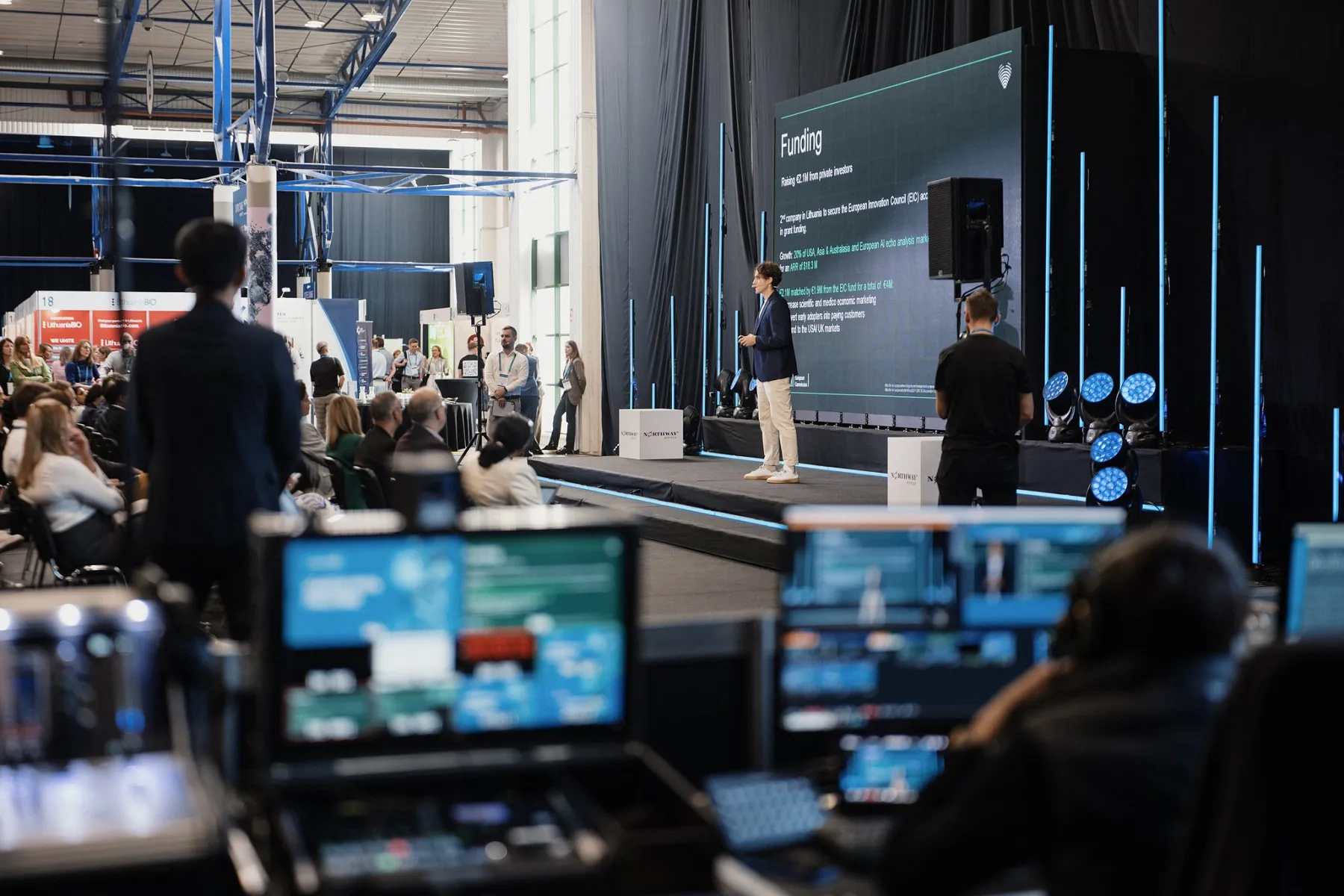
Free Bionics Taiwan, an exoskeleton product developer and startup from Taiwan, won the first prize in the Life Sciences Baltics Startup Pitch Battle and will do an internship at the Akron Accelerator in the USA. Other startups such as Innosensus, which is developing a mobile device to help celiacs determine the gluten content of their meals, and Biognr, which is developing innovative raw materials for the food industry, have also been recognised and awarded sponsor prizes.
“We are delighted that this year’s Startup Pitch Battle competition has attracted interest from international investors and life sciences startups. We received more than 40 applications for the competition and selected 10 teams with the highest potential. The Lithuanian life sciences startup community, consisting of about 80 innovative businesses, has been growing rapidly recently because, as the #hitEnergy example shows, scientists have been finding their way into business increasingly faster,” says Paulius Petrauskas, the Director of the Innovation Department of Innovation Agency Lithuania, which organised the Life Sciences Baltics Forum. .
The winners were selected by a panel of investors and scientists: Sandra Golbreich, Founder of Baltic Sandbox Accelerator and General Partner of Baltic Sandbox Ventures, Donatas Keras, Founding Partner of Practica Capital, Aurelija Rutkauskaitė, Partner of Trinity Jurex, Erin Gainer-Grigaliūnė, philanthropist, founder and CEO of The Ella Fund, a women’s empowerment foundation, Rita Sakus, Board Member of the European Business Angels Network (EBAN) and one of the founders of the Lithuanian Business Angels Network (LitBAN), and Viktorija Trimbel, Managing Director of Coinvest Capital.
Resilient to economic crises
Andrius Milinavicius, Founder of Baltic Sandbox Ventures, an accelerator, scouting for scientifically-led solutions, says life sciences is a vibrant field and covers tremendously impactful solutions. “Yes, it is usually tightly connected to your expertise and takes longer until a particular level of confidence and development. But at the same time, it always retains the value created – the promise of intellectual property. In comparison, if we compare life sciences to more generic b2b solutions, these come with a burden of heavy investments in marketing to keep the valuation going up. Scientifically driven solutions come with a completely different set of rules”, explains Milinavicius.
Listing appealing sector trends, Milinavicius says that we’re living through a revolution some call techbio – humanity has attained the ability to program biology as if it was a programming language. Functional genomics, gene editing, digital twin solutions, computation and AI use in the drug discovery field, and many more – all this makes life sciences an exciting playground which, after the Covid pandemic, has lost its limits and borders – it does not matter where the innovations come from, it is the result they can achieve and what it takes to speed it up.
According to Milla Koistinaho, Founding Partner of Innovestor Life Science Fund, investing in biotech and digital health within Life Sciences in the Nordic and Baltic countries, biotech investing is typically less dependent on economic cycles than many other sectors.
“Despite economic downturns, there is a desperate need for breakthrough medicines for diseases like cancer, dementia, and heart diseases, and while the population is aging, these diseases cause an immense burden on healthcare and our societies. New targeted solutions are needed to address various health challenges and improve quality of life”, she says.
She admits that the Baltic biotech and startup ecosystem is evolving and gaining recognition for its investments and contributions to entrepreneurship, translational research, and innovation. “We have seen exciting opportunities, especially in digital health, digital therapeutics, personalized medicine, and biotech platform technologies. Incubators and accelerators offering mentorship, access to laboratory facilities, business development support, and networks to investors are crucial to the region”, says Koistinaho.
In recent years, the Lithuanian life sciences sector has grown by an average of 30 per cent per year. The contribution of this sector to GDP in 2022 reached 3 per cent, and the Lithuanian economy is targeting a 5 per cent contribution of this sector to GDP by 2030.
Life Sciences Baltics, the largest life sciences forum in the Baltic countries, has been held every two years since 2012. It brings together scientists, entrepreneurs, startups, investors and policy-makers to discuss key ideas and transformations in the field of life sciences. Life Sciences Baltics consists of an international conference, a trade show, business meetings and a startup pitch competition.