Lithuania’s innovation ecosystem has long since crossed the boundaries of local projects, and support from the European Space Agency (ESA) is opening up more and more opportunities for Lithuanian companies to establish themselves in the international market. In total, Astrolight has already received around 1 million euros in funding from ESA.
“The potential of Lithuania’s space industry is enormous. Companies like Astrolight create innovations that not only help solve Europe’s current security issues, but also establish our country as a reliable high-tech developer. International projects and partnerships only confirm that Lithuanian companies have something to offer the global market,” says Eglė Elena Šataitė, head of the Innovation Agency’s Space Hub LT group.
The Path to Innovation – From NanoAvionics to Astrolight
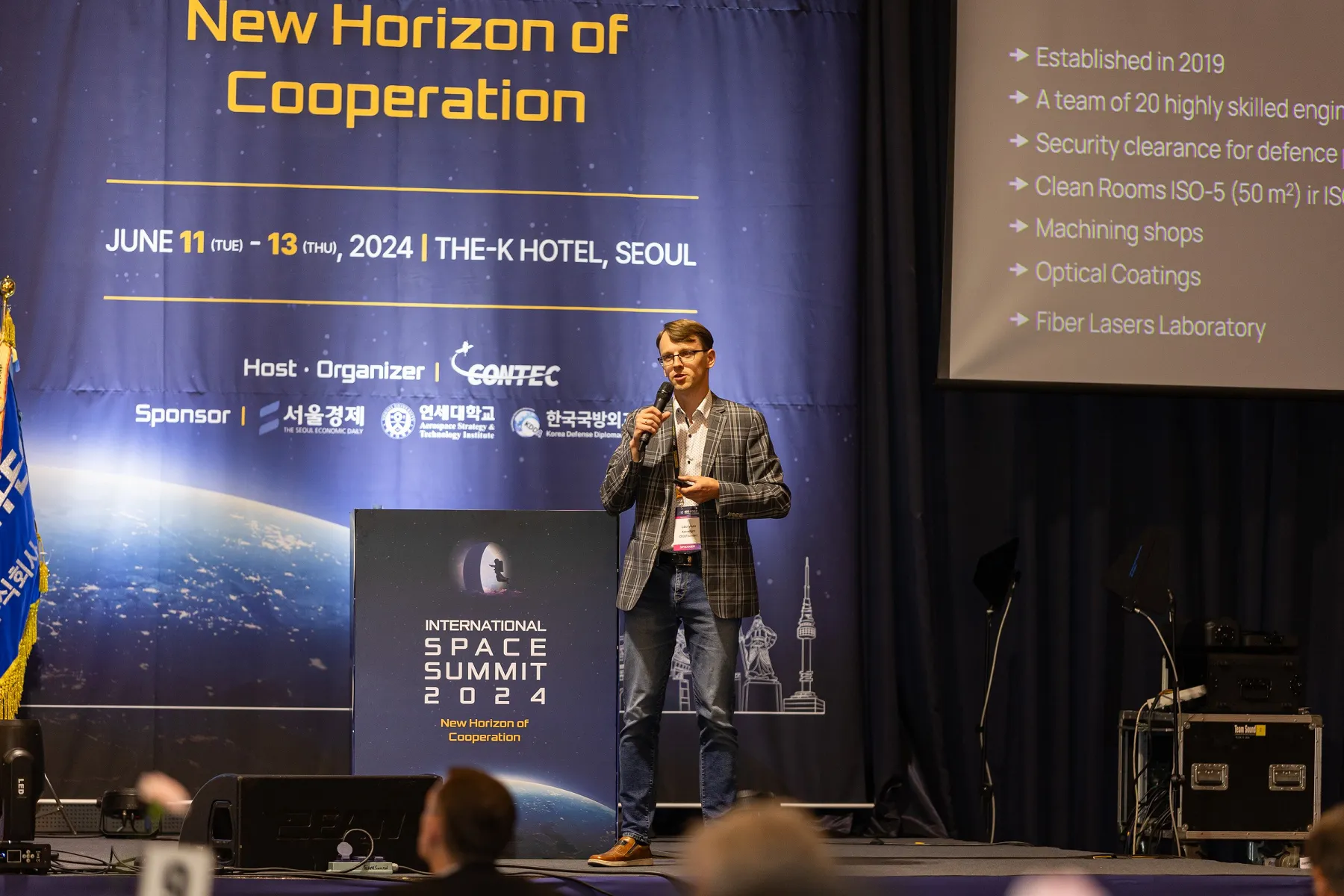
Laurynas Mačiulis, co-founder of Astrolight, is certainly no newcomer to the field of space engineering. Before founding Astrolight, he and his colleagues established NanoAvionics – a company that became one of the world leaders in the production of small satellites. In 2019, he took on a new challenge and assembled a team with an ambitious vision – to create laser communication technologies that would expand humanity’s communication possibilities both on Earth and in space.
“Our path into the space industry began with engineering curiosity and a desire to create technologies that have a real impact on the world. You don’t become a millionaire in this field overnight – it’s an area that requires years of work, stress, and challenges. Nevertheless, we believed and still believe that our technologies can change the world for the better,” says Mačiulis.
Astrolight’s laser communication technology offers fundamental advantages over traditional radio wave systems. Its ability to precisely focus energy reduces signal loss and ensures impeccable connection quality even over extremely long distances. Moreover, the narrow laser beam is resistant to interference and practically impossible to intercept or disrupt by electronic warfare means.
“It can be compared to fiber-optic internet. It changed the world because it enabled the fast and efficient transfer of huge amounts of information. We’re doing the same, just without the fiber – using laser beams that transmit information over thousands of kilometers, between Earth and space or between satellites,” Mačiulis explains.
Innovative Solutions: ATLAS, HERMES, and POLARIS
Astrolight is developing three main products that not only change the rules of space communication but also expand the limits of technology applications:
-
ATLAS – a laser communication device designed for satellites, ensuring secure and fast data transfer from space to Earth and between satellites themselves.
-
HERMES – a ground-based optical communication station that receives and sends signals between Earth and space. To ensure communication stability under any conditions, Astrolight plans to deploy these stations in various parts of the world.
Although, according to Mačiulis, Astrolight’s main goal has always been the improvement of space communication, the growing security needs in the Baltic region encouraged the company to also direct its innovations toward the defense sector.
-
POLARIS – a specialized solution for the defense sector, ensuring reliable communication between ships even under radio silence or interference conditions. Developed together with the Lithuanian Navy, this technology is expected to demonstrate its potential already this year.
Global Ambitions and the Road to Security
Another step for Astrolight in the direction of defense technologies was being selected among the top 10 NATO DIANA innovators. This international recognition opened new doors for the company, not only providing 300,000 euros in financial support, but also allowing it to establish valuable connections with NATO structures and potential investors. During the accelerator program, the company also attracted talented specialists who have become an important part of Astrolight’s growth.
“The NATO DIANA program was one of our most significant stages, enabling us to further establish ourselves in the space and defense industries as developers of innovative communication solutions. This experience provided the necessary resources and the opportunity to forge stronger relationships with partners around the world,” says Mačiulis.
Astrolight’s current development plans include not only Europe, but also the Arctic region. A newly established subsidiary in Denmark marks a new stage in the company’s global ambitions, focused on applying innovative communication solutions in both commercial and defense sectors.
“Our ambition is to become a global leader in space laser communication. We want our technologies to help humanity communicate faster, more efficiently, and more reliably. If not in five, then in ten years, I personally hope that a Lithuanian Astrolight laser will be used to broadcast humankind’s landing on Mars,” Mačiulis shares his dream.