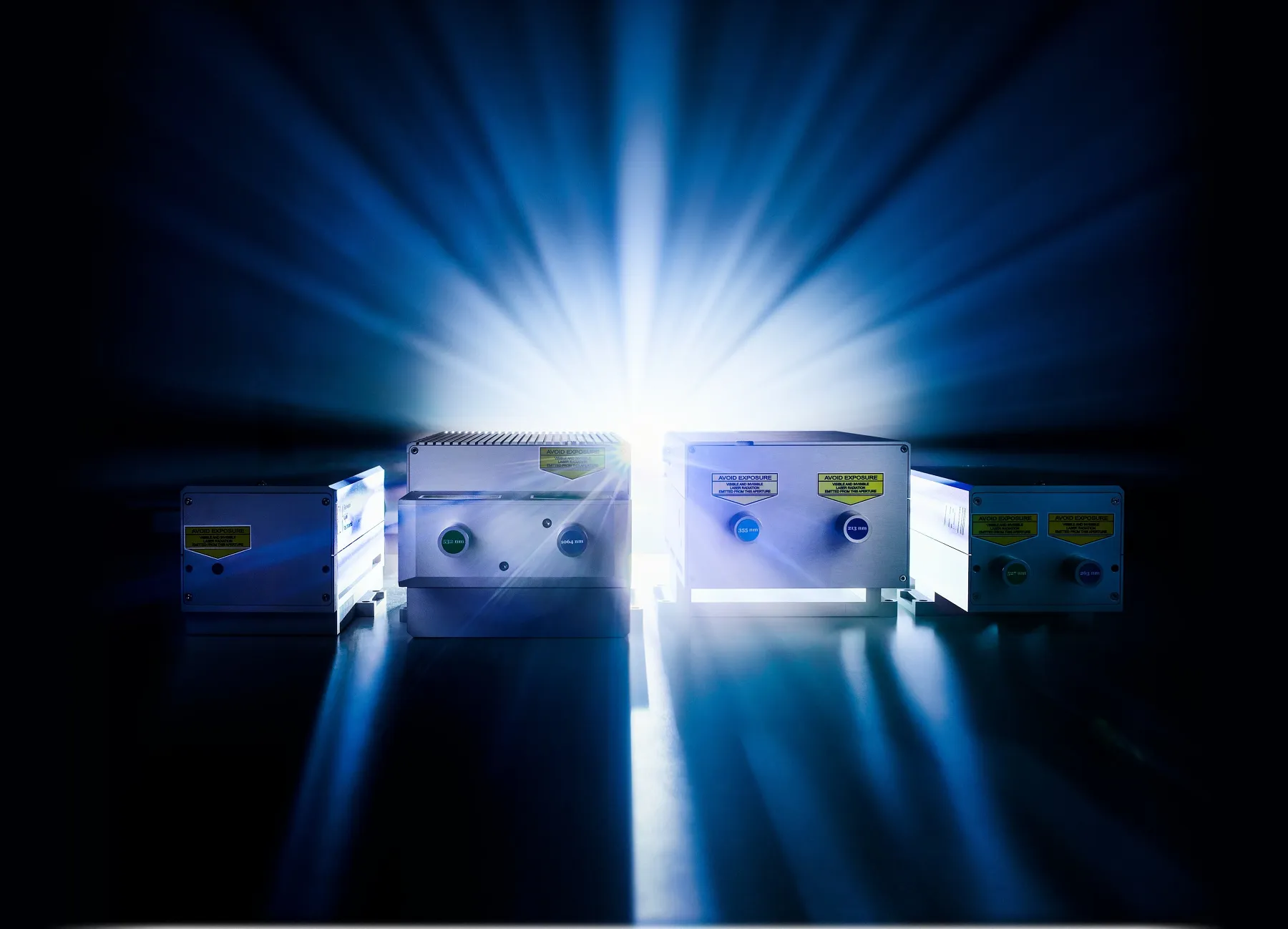
According to Andrias Rinkevičius, the head of Quantum Light Instruments, a situation arose when the need for a new device was felt on the market, there was already an idea, and the available experience would make its realisation possible.
To develop this kind of a laser required a lot of investment, and the project was implemented by the company using the Experiment measure of the Innovation Agency, which is aimed to promote research and development and innovation and is financed from the funds of the European Regional Development Fund.
”Innovations stem from hard work and new ideas. However, realisation of ideas sometimes requires additional financial stimulus. It’s great to have been able to help the Lithuanian laser developers on their way towards their goal,” says Inga Lukošiūnaitė, head of the Science and Innovation Department of the Innovation Agency.
The idea was dictated by market demand
A. Rinkevičius reveals that he started thinking about this laser when he received signals from university researchers and market participants that the semiconductor industry needs devices with longer wavelengths than are usually used, and it would be good if the wavelength could be adjustable.
“We had experience in constructing similar lasers, however, we had never done one like DIDADELA. For example, until then we manufactured lasers with a pulse repetition frequency ranging from 10 to 100 Hz, and the frequency of the new device is 10 to 100 kHz, that is, it is 1 000 times bigger. Besides, the specifics of the laser working environment had to be considered. If it used in an industrial environment, its resistance to temperature changes, dust, and other parameters must be much higher,” says A. Rinkevičius.
The device will allow to examine live tissues
“We have to be at the forefront, because half of our equipment goes to universities – we must know in which direction the science is moving, what scientists are looking for, and roughly what equipment they might need in new research,” says A. Rinkevičius.
According to him, construction of the new laser required study of research, adaptation to different parameters, search for possible improvements, what mechanical and electronic components should be fitted in the device.
The laser constructed by the Lithuanians can be used for micro-processing, which is highly precise processing of materials, where the accuracy of execution is measured at micrometric scale, i.e., thousandths of a millimetre. Usually, this type of processes are used in semiconductor production when processing silicon wafers, manufacturing LED lights, solar energy cells.
“This laser can also be applied in biomedical research. There is a branch of research, called photoacoustic microscopy – the beam of a laser through a microscope produces an acoustic response of certain frequency, according to which an image is generated. The advantage of this research is a possibility to examine a living tissue without causing any damage to it,” says the Head of Quantum Light Instruments.
The first trip is to the USA
In the nearest future, the laser will travel to the largest exhibition of laser technology in San Francisco, USA. The USA were chosen for the presentation for the reason: the Lithuanian company sells 60 per cent of its produced equipment here – local universities, private companies and defence sector representatives are the buyers. It can be said that the lasers produced by the Lithuanian company can be found in the largest US laboratories.
About 20 per cent of the lasers manufactured by Quantum Light Instruments stay in Europe, mainly purchased by organisations in Germany and France. The remaining 20 per cent is exported to Asia: Japan, South Korea, and Taiwan.